Pack of 10 volley balls x10

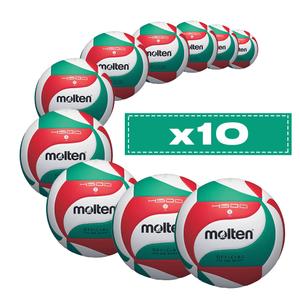
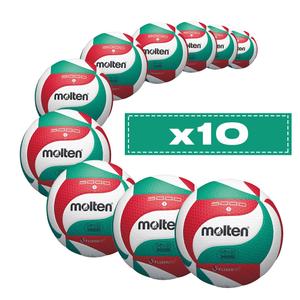


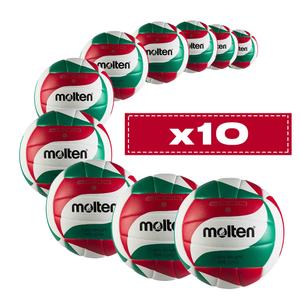
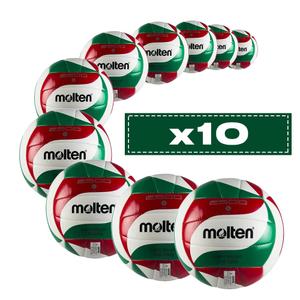


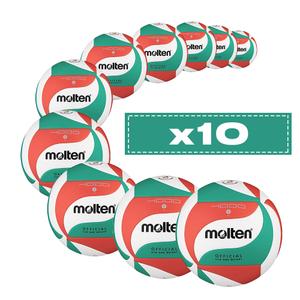


For a club, the set of 10 volley balls transforms a session: each pair has their own ball for passing, setting, and serving, and no one is left waiting for the ball that rolled under the stands.
Approved indoor balls, lightweight training models or sand balls: the page offers each model in complete kits, to equip a team or a volley school in one go.
Pack of 10: one ball per pair, a session that doesn't stop
The pack of 10 meets a simple requirement: during warm-up, players work in pairs. With a full set, a team and its substitutes can keep going with digs, passes, and attacks without a break. The coach also keeps a few balls in hand to start defensive drills, while the rest of the group continues to play.
Match ball or training ball: the right choice for a kit
For a club competing in a league, the kit is used to prepare for matches: it's better to train with the ball that will be used on the weekend. The Molten V5M5000, approved by the FIVB, and the Mikasa V200W, the ball for international competitions, serve this purpose. For a volleyball school or a youth section, a lighter training model, like the Molten V5M2000-L, is easier on beginners' forearms.
A sand kit for beach courts
Part of the packs of 10 is designed for beach-volleyball. A club that opens its sand courts in good weather can find the OPTX AVP from Wilson, the Mikasa Beach Classic BV551C, or the women's beach balls from Molten. Keep this kit for the sand: a beach ball, which is softer, does not behave the same way on a wooden court.
Molten, Mikasa, Wilson, Nike: what each brand includes in the pack of 10
- Molten covers the entire range, from the FIVB-approved V5M5000 to the V5M4500 and V5M4000 for clubs, down to the V5M3500 and V5M2501-L for training sessions.
- Mikasa offers its competition models, the V200W and V300W, as well as the V330W and V355W-L for training.
- Wilson provides the Helix, an indoor match ball, the OPTX FIVB Game Ball, and the Thrive, alongside its sand balls.
- Nike rounds out the page with its All Court, designed for playing both indoors and outdoors.
Inflating and maintaining ten balls without spending the evening
A needle pump and a pressure gauge save valuable time. The recommended pressure is noted near the valve of each ball: adjust them all to the same value, or players will feel the difference from one exercise to another. A ball bag keeps the kit together between the equipment room and the court, and prevents a ball from disappearing into a parent's trunk.
Fewer than ten balls or a budget-friendly kit
For a smaller need, the intermediate and compact sizes have the same models, and the page ball packs brings them all together like this. On the budget side, check out the special ball offers, the Black Friday ball deals at the end of autumn, and then the ball sales.
Frequently Asked Questions
How many balls do you need for a volleyball training session?
Count one ball for every two players during warm-up, and a few extra balls for the coach during defensive drills. The pack of 10 thus covers a full team along with its substitutes. For a large volleyball school, two kits are not too many.
Can a pack of 10 mix several models?
No, each pack contains ten identical balls. This is actually what a coach is looking for: the same feel and trajectory for the whole group. To have match balls as well, add a second pack of a different model.
Do you need the same ball as the one used in league matches?
This is recommended once the team is competing. Check with your league or committee about the ball required for your level, and then choose the training kit accordingly. For recreational play and youth, a training ball is sufficient.
How do you store a ball kit during the summer?
Deflate them slightly and store them away from heat and humidity, away from a window that gets direct sunlight. A location that's too hot can damage the bladder and the covering. Inflate them to the correct pressure a few days before resuming.
Can an indoor ball kit be used outside?
Occasionally, on a clean surface, yes. Asphalt and gravel can quickly wear down the glued panels of a competition ball. For frequent outdoor play, reserve a versatile model like the Nike All Court or a training ball.